1. Christophe Leclercq is an active business angel in three social media ventures while directing Europe MediaLab and is involved in the pre-selection process. Isn’t this an inherent conflict of interest? Are any of the laureate companies ones he has invested in?
Europe MediaLab established a firewall precisely to prevent any conflict of interest. Christophe Leclercq has zero voting rights and does not sit on the Attribution Committee. The final selection is conducted entirely by an independent committee of external industry leaders. The committee received full investment disclosures before deliberations, ensuring every evaluation was based strictly on external merit.
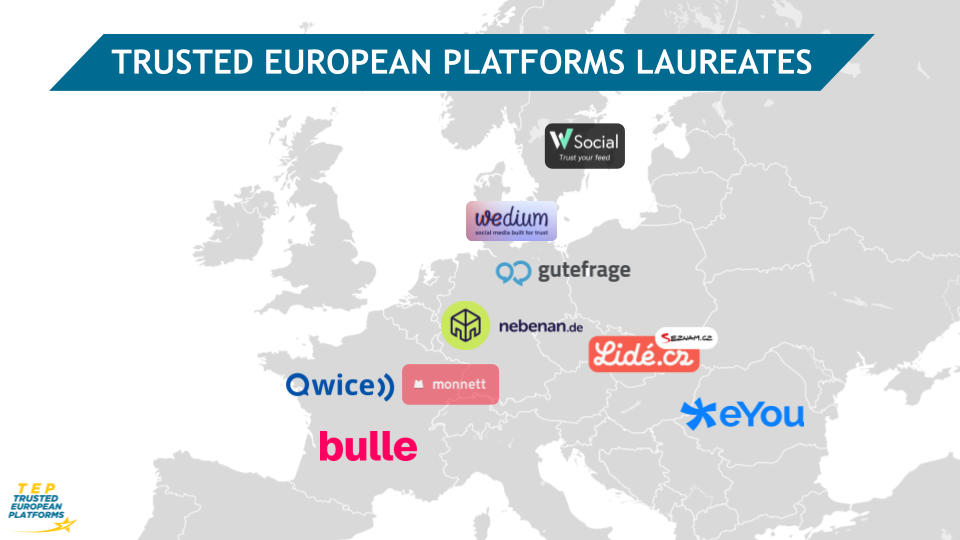
Europe MédiaLab’s press release on TEPs also disclosed this potential conflict of interest. Christophe has invested part of the proceeds from selling the media Euractiv.com. Namely in 3 ventures: W Social, eYou Social and wedium. In every case, he is also in an advisory organ (not in any legal or financial decision-making body).
2. Europe MediaLab’s internal team filtered 45 applicants down to 15 before the independent committee saw them. Doesn’t that give your internal team de facto veto power over who can receive the label?
The pre-selection process was strictly procedural and based on verifying baseline eligibility against published criteria rather than qualitative assessment. Narrowing the pool from 45 to 15 applicants provided a structured pipeline, enabling the Pre-selection Team to concentrate on evaluating viable, high-potential platforms instead of basic administrative screening.
The Attribution Committee retained full visibility over the process and held independent authority to review, challenge, or deviate from internal scoring.
3. Your laureates range from local neighbourhood apps like nebenan.de to legacy Q&A and community portals like gutefrage.net and Lidé.cz. How do they qualify as ‘trusted public spaces’ defending European democracy?
European digital sovereignty cannot be achieved solely by launching clones of X or Facebook. Healthy public discourse happens across diverse community formats: local neighbourhood networks, peer-to-peer knowledge hubs, and general forums. The TEPs label deliberately includes ‘National Champions’ alongside ‘European Challengers’ and ‘Beginners’ to prove that viable, privacy-compliant European alternatives already exist across multiple verticals.
‘Trust’ is not an aesthetic label; it is evaluated against structural criteria including algorithmic accountability, compliance with European data privacy standards, and content integrity. Platforms like gutefrage.net and nebenan.de have operated under European regulatory frameworks for years without relying on the opaque, hyper-polarising ad algorithms characteristic of non-European giants.
4. The evaluation relies primarily on self-declarations rather than independent audits. How can you guarantee the accuracy of platform compliance without rigorous verification?
The initial evaluation framework relies on a structured self-declaration mechanism verified against objective eligibility benchmarks. This approach keeps the application procedure accessible and entirely free of charge for emerging digital platforms.
Subject to securing additional funding in future iterations, we might integrate comprehensive audit mechanisms to further reinforce verification standards.
5. Attribution Committee member Clare Melford leads the Global Disinformation Index (GDI), an organisation that has faced blacklisting (and allegations of censorship), after which she was denied a US visa. Is the TEPs label being used as an ideological vetting mechanism?
The Attribution Committee is a diverse, six-member panel bringing together venture capital, advertising economics, public service broadcasting, and brand associations. No single individual dictates the outcome. Members serve strictly in a personal capacity to evaluate operational integrity and platform resilience, not political opinions.
Clare Melford was invited because of her recognized technical expertise in brand safety and platform transparency metrics. Clare and Christophe met on the Advisory Board of EDMO European Digital Media Observatory. Evaluating whether platforms protect users from automated disinformation is essential to making European media spaces secure and commercially viable for advertisers.
6. Big Tech captures more than 90% of Europe’s €49 billion ad market. Isn’t awarding a label to tiny apps and early-stage startups mere symbolic ‘sovereignty-washing’ that will make zero difference to Big Tech’s monopoly?
Every major tech ecosystem begins by identifying and nurturing its early challengers. Dismissing nascent European players as ‘too small’ guarantees perpetual foreign dependence. The TEPs label gives promising ventures some visibility help, in order to attract European VC funding, forge media partnerships, and scale into genuine challengers over time.
Major advertisers want brand-safe, trusted European platforms, but the European market is currently fragmented. Advertisers require clear standards and aggregated alternatives. By using a common label, we may help the TEPs platforms reach the collective scale necessary to capture a share of that market, if they wish to cooperate.
7. Only 7 European countries are represented among the 10 laureates, with half of them based in Germany and France alone. How can you credibly present this as a pan-European initiative when 20 EU member states are completely absent?
The TEPs label is free of charge, unlike most certification processes.
This announcement marks the inaugural cohort of a multi-year project. In Year 1, we evaluated the most operational inbound applications available within our launch window. Having platforms from 7 countries (including Croatia, Czechia, Romania, Luxembourg, and Sweden) is a balanced foundation that we intend to expand significantly in Year 2 and beyond.
The label prioritises platforms designed for cross-border scalability. So the location of the initial HQs is not as important as the European ambition. The goal is not to have 27 winners but multiple ones at European level.
8. Europe MediaLab explicitly mentions seeking commercial sponsors for Year 2 and introducing ‘trust-based ads’ for label winners. Is this label a pay-to-play scheme designed to generate commercial revenue for your organisation?
Europe MediaLab does not act as an ad broker and does not take venture capital cuts. Facilitating ‘trust-based ads’ refers to connecting certified platforms with mainstream advertisers who want ethical, brand-safe European inventory. Our goal is to ensure the platforms themselves monetise sustainably, keeping European ad spend within Europe.
Europe MediaLab is a non-profit foundation initiative (formerly Fondation Euractiv). No platform paid to apply, and no laureate pays for the label. Sponsorship for Year 2 is sought to cover administrative costs (personnel, office, etc.), while preserving the impartiality of the attribution process. Contacts are welcome
Among the 15 platforms, we also invited Eurosky / Mu and Mastodon, but both did not apply.
9. What happens when one of your labelled ‘trusted’ platforms fails to moderate illegal content, spreads hate speech, or is acquired by an American or Chinese conglomerate?
The TEPs label is not granted indefinitely. As outlined in Step 5 of our process, the team and committee, if continued, may monitor with Europeanness criteria.
If a platform alters its governance, compromises content integrity, or cedes controlling ownership to non-European entities, the Attribution Committee would retain full power to revoke the label immediately.
If there is a year 2 of the TEPs label, it may well be imposed further: the best grader for European ownership are given to venture using shareholder agreements or golden shares to maintain ownership in Europe: these are difficult to change, especially as they would appeal to shareholders that make them, such as impact investors, family offices and, in due course, sovereign funds.