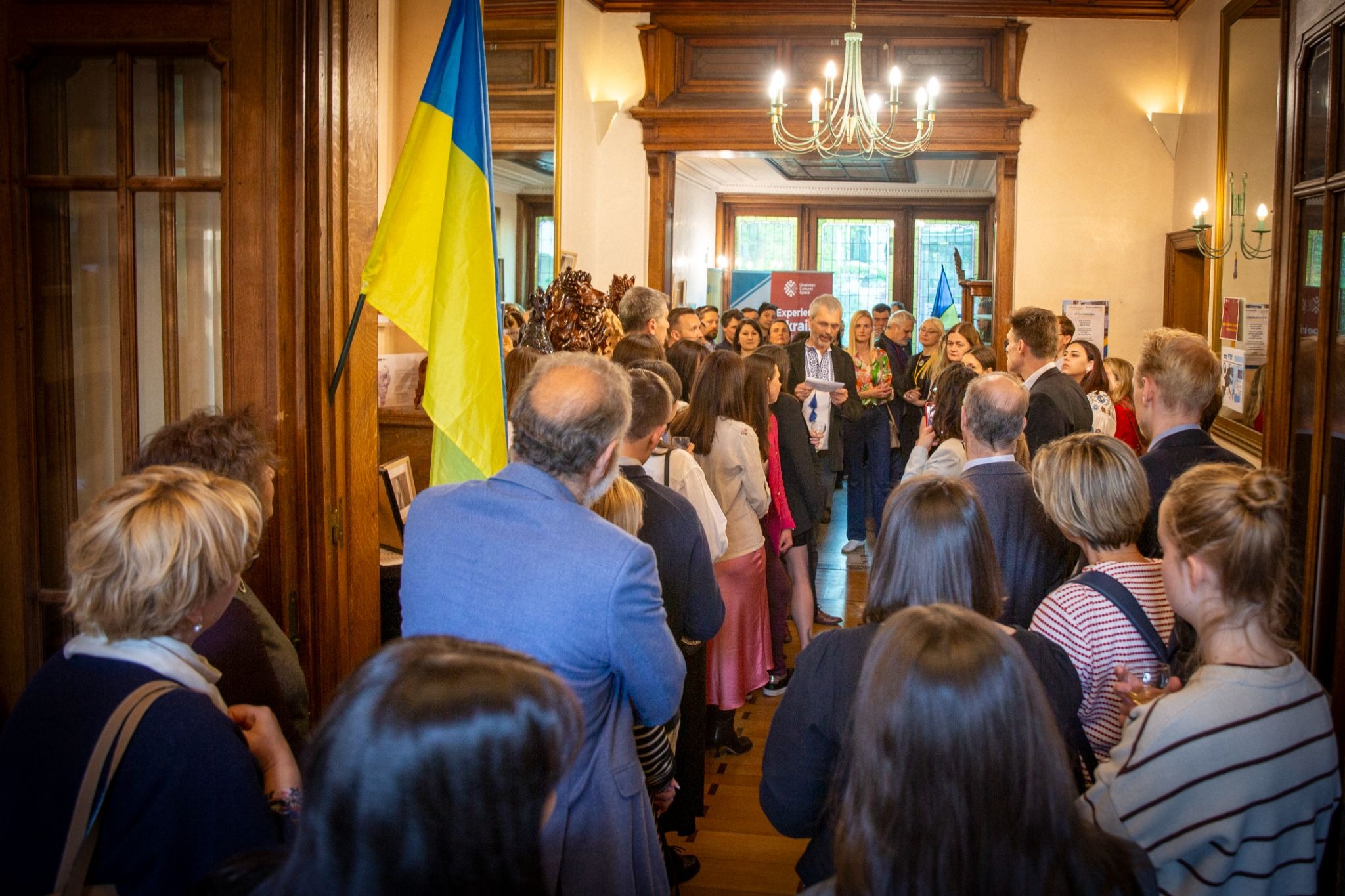
Maison du MédiaLab: journalists from Eastern Europe in Brussels
EU and NATO membership shape political debate across Eastern Europe, but the region has few correspondents in Brussels to cover them. Eastern European media are eager to expand their presence in Brussels – the Maison du MédiaLab programme helps them get started.
“As journalists, you have the power to cut through the noise, establish the facts and translate the complexities of our Union into stories that resonate with the people in your countries.”
– Marta Kos, EU Commissioner for Enlargement
“The media sector is under tremendous pressure. This project makes a difference. It helps transmit quality information to the people.”
– Vselovod Chentsov, Ukraine’s Ambassador to the EU
We host and integrate independent correspondents from Armenia, Georgia, Moldova, and Ukraine, providing temporary housing, mentoring, and networking opportunities.
Publications by resident correspondents
Help independent Eastern European journalism have a voice at the heart of Europe.
Make a donation via the King Baudouin Foundation
Tamta Nachkebia
Publika (Georgia), third wave correspondent
Helping independent media to have a correspondent in Brussels and ask questions to people in the decision-making processes related to Georgia is very important. Without the Maison du MédiaLab, I would never be able to do this by myself. And this programme is important not only for Georgia, but for everybody in the region – we are facing so much propaganda, so many lies, and so much pressure. This is real help.
Lusine Vardanyan
CivilNet (Armenia), third wave correspondent
Now that Armenia has started accession to the European Union, it’s especially important to have Armenian journalists here to cover everything from Brussels – there are so many misunderstanding about the EU in Armenia.
Iulia Sarivan
Jurnal TV (Moldova), first wave correspondent
I had the opportunity to spend six fantastic months in Brussels thanks to Europe MediaLab, which provided us with guidance and accommodation in the heart of the city. I applied for the programme with a clear goal – to better understand how the European Union functions and to be at the center of the decision-making in Brussels.
It wasn’t easy, but it was absolutely worth it. I achieved my goal, and more – I will continue to work as a Brussels correspondent. This also benefits our viewers, as I can now explain more clearly what is happening behind the scenes at the heart of Europe.
This experience shaped me not only as a journalist, but also as a person. Living and working in Brussels exposed me to a diverse international environment. (…) It has made me more open-minded and curious, qualities that enrich both my personal life and professional work.
Olha Kyrylova
Telegraf.ua (Ukraine), second wave correspondent
One of my topics of interest is security and defence, and I’m really glad that I can cover this from Brussels. In the last few months, the EU launched many new defence programmes, and it’s important that Ukraine is part of these programmes. For me, it is important to bring information about this to the audience back home, and to give the people the understanding that Europe and Ukraine are united.
I’m really grateful for the Maison du MédiaLab programme, because it really contributed to my growth as a professional. It also gave a one of a kind opportunity for me to bring in-depth analysis of policy-making in Brussels back to my audience in Ukraine, to the audience of Telegraf.
Selection Committee
Participating media outlets are selected by a Selection Committee, currently comprising Europe MediaLab (pre-selection and chair), EFJ (European Federation of Journalists, representing journalists’ trade unions and associations), and API/IPA (International Press Association, representing the Brussels press corps). This Committee takes final decisions, without vetting by the EU institutions or governments of covered countries.
Partner media outlets vary in type, including newspapers, online media, web-based and social media, news agencies and analytical newsrooms, or TV and radio stations.
Christophe Leclercq
Chair of Europe MediaLab
Chair of the Selection Committee
Ricardo Gutiérrez
General Secretary, European Federation of Journalists
Dafydd Ab Iago
President of API/IPA
The main selection criteria are composed of editorial independence, content quality, and the size and type of audience.
Journalists are selected on the basis of their professional focus and experience, as well as their proficiency in English and other languages.
Once in residence, they report on the European Union and its institutions, as well as NATO, producing coverage in their own languages for audiences in Armenia, Georgia, Moldova, and Ukraine. Their editorial independence is fully preserved as neither Europe MediaLab nor its partners have any say in the nature or content of their reporting.
Meet the current, fourth wave of residents
Karine Asatryan
Factor (Armenia)
Samson Martirosyan
Hetq (Armenia)
Yuliia Hyra
Babel (Ukraine)
Cătălin Volconovici
NordNews (Moldova)
Maxim Bolohan
IPN (Moldova)
Giorgi Edilashvili
Tabula (Georgia)
Current partners and supporters of the Maison du MédiaLab programme
The Maison du MédiaLab is proud to work alongside a growing network of institutional, media, business, and civil society partners who share our commitment to supporting independent journalism from Eastern Europe.