
Stay Updated with our newsletter
4.000+ subscribers
Whether you are a journalist, institution, or funder, get our monthly roundup of news, insights, and events related to the work of Europe MédiaLab.
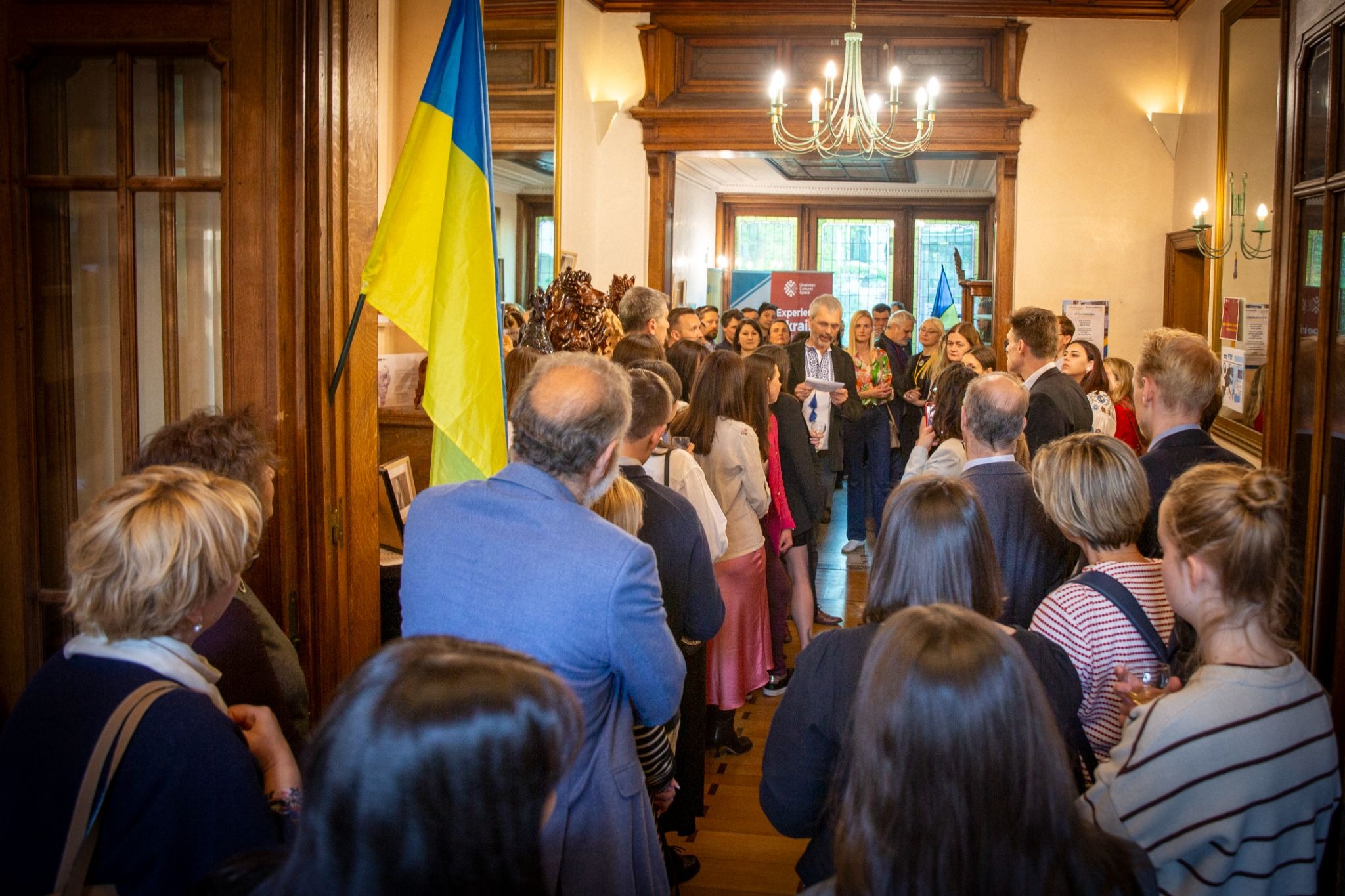

On the 22nd of April, Europe MédiaLab, Ukrainian Cultural Space, Get Ready for Europe, and the State Service of Education Quality of Ukraine organised a reception to celebrate Ukraine’s traditions. Taking place after the EU–Ukraine Business Summit, this special event helped engage with speakers and attendees, plus connect with the Ukrainian community in Brussels.

Guests explored the Borscht Expo, which showcases Ukraine’s soup, recognised by UNESCO as part of the Intangible Cultural Heritage of Humanity. In addition, Traditional Ukrainian ceramic artworks, Lembyk sculptures, were exhibited. Participants also tried traditional dishes, such as borscht, salo, and varenyky.

At the event, the team was glad to welcome Catherine Magnant, Head of the Cultural Policy Unit of the European Commission, and Natalia Shapoval, Vice President for Policy Research at Kyiv School of Economics. They made short statements, together with Christophe Leclercq and Inga Yakymenko, Founder of Ukrainian Cultural Space, the co-organisor.

«Ukraine’s culture is part of Europe’s culture», said Catherine Magnant (European Commission).
«The future is happening now in Ukraine — scary, yes, but also alive with economic innovation and culture», added Natalia Shapoval (Kyiv School of Economics).
This month, a new Georgian resident joined Maison du MédiaLab! Together with the team, they attended the photo exhibition “Georgia in Focus”, hosted by the European External Action Service (EEAS). The exhibition shows the most defining moments of Georgia’s recent history through the lens of Georgian documentary photographers, serving as a tribute to the resilience, professionalism, and courage of the country’s independent media. This message resonates deeply with Georgian current and former residents: they went through the same challenges.


On the 21st of April, Maison du MédiaLab welcomed a delegation of Ukrainian and Armenian journalists along with civil society representatives visiting Brussels. The visit took place as part of the MERIT Forum organised by the International Media Support, a Danish NGO dedicated to strengthening local media in challenging environments around the world. After visiting Maison, the group enjoyed an informal exchange over lunch.

On the 12th of April, Péter Magyar’s Tisza party won the elections in Hungary. This result is particularly important for Ukraine and Moldova, two countries whose EU accession paths have been repeatedly stalled by Orbán’s vetoes. Maison du MédiaLab residents followed the story closely, reporting extensively for their home audiences, not only from Brussels. Among them, Milana Holovan, correspondent of Liga.net (and second wave maison participant), travelled to Budapest to cover the elections on the ground.
On the 12th April, Carina Muller joined some Moldovan EU officials in Brussels to celebrate Orthodox Easter, also known as Paște. Orthodox Easter is one of Moldova’s main celebrations: a deeply religious and family-oriented occasion marked by midnight church services, red-dyed eggs symbolising the blood of Christ, and traditional foods. Carina documented the celebration in Brussels throughout the day, filming and producing a report for TVR Moldova.

Support for Trusted European Platforms (TEPs) is growing among policymakers in the European Commission and European Parliament, as well as journalists’ associations, NGOs, and other stakeholders keen on media involvement. The criteria defining TEPs and the framework for the TEP Club are taking shape, with first memberships and sponsorships on the horizon. Expected TEPs label launch: Vivatech, Paris, 17/19 June.
Carina Muller
TVR Moldova (Moldova)

This month, Carina Muller reported on the results of the Hungarian elections, including quotes from the Vice-President of the European Parliament and European Commission spokespersons. She also wrote on the European Commission’s reaction to Plahotniuc’s conviction.
Tetiana Litvinova-Mykhalonok
Hromadske Radio (Ukraine)

In April, Tetiana Litvinova-Mykhalonok interviewed MEP Helmut Brandstätter on the impact of Hungary’s elections on Ukraine‘s access to the EU. She also covered the approval of the €90 billion loan to Ukraine and the 20th package of sanctions against Russia.


